
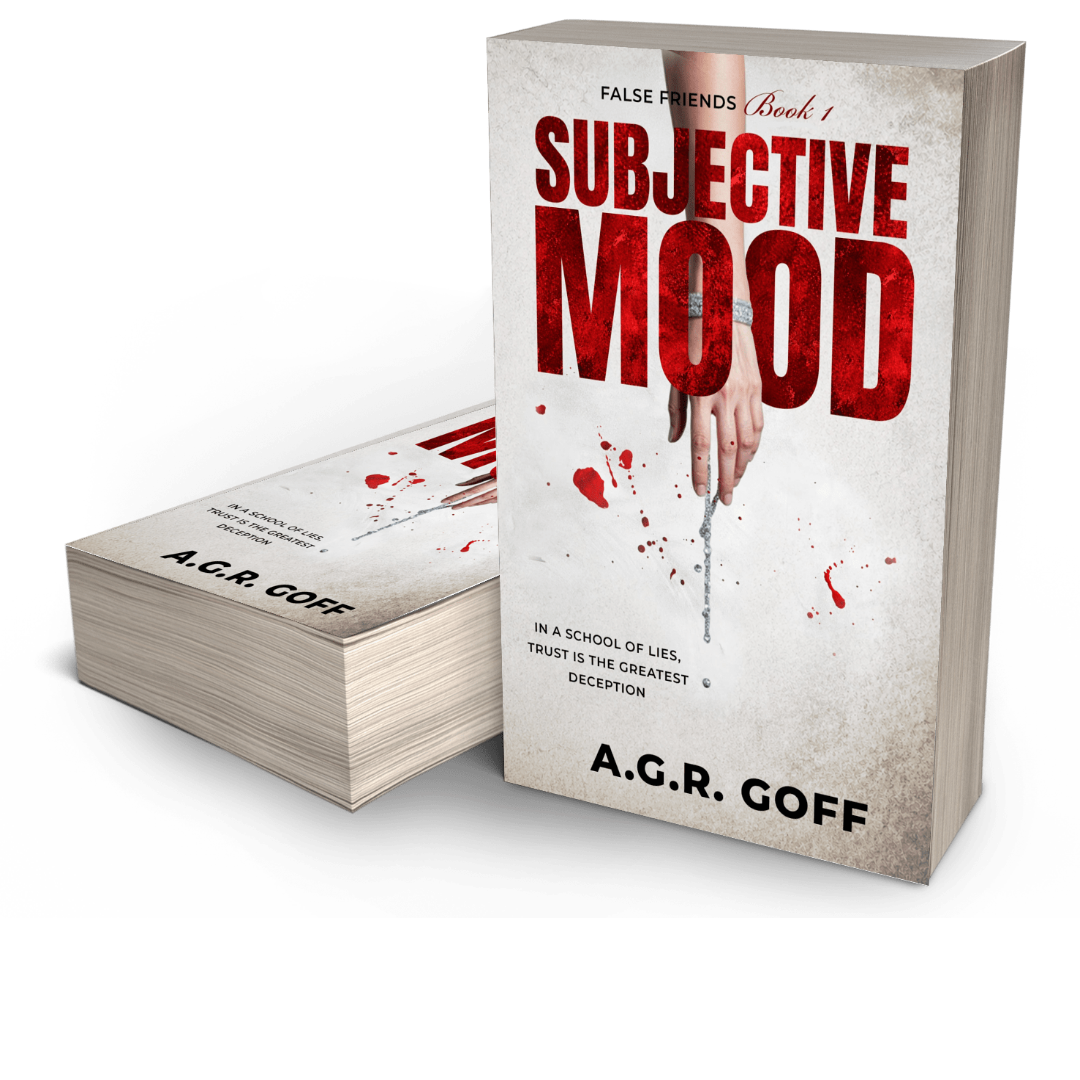
Some lessons change more than the way you speak.
In the coastal town of George, South Africa, Bianca meets Ramón - a magnetic language teacher whose fascination with words runs far deeper than grammar. When he invites her to join his school, Instituto Guerrera, in Málaga, Spain, it feels like a chance to start over.
But the prestigious institute isn't what it seems. Beneath its polished surface lies a quiet network of control, silence, and obsession - a place where language shapes more than thought, and meaning can be turned against you. As Bianca's sense of self begins to erode, she must decide whether she's mastering a new language... or being rewritten by it.
Subjunctive Mood is the first novel in the False Friends Series - a psychological thriller about power, desire, and the dangerous ways communication can deceive. Inspired by real people and a real school, it blurs the boundary between truth and fiction, reminding us that words can both reveal and destroy.

Reviews
I received the paperback of Subjunctive Mood as a present and didn’t really know what to expect. What surprised me most was how different the story felt. Bianca’s situation immediately creates tension, while Ramón’s perspective adds another angle that slowly makes things feel more complex. The connection to Instituto Guerrera develops later and suggests there is more to come in the series. It’s not a typical fast thriller, but it stays in your mind and makes you curious about the next book.
I liked this book a lot. Having the story take place in Málaga and mostly around a language school was something I hadn’t come across before, and I enjoyed getting to know Bianca and the people she meets there.
Things get stranger as the book goes on, and I kept changing my mind about some of the characters and whether Bianca could trust them. There were a couple of places where I thought the story dragged a little, so for me it wasn’t quite five stars. But I wanted to know what was happening a
Subjunctive Mood doesn’t hand the reader clear answers. Instead, it leaves a lot open to interpretation, with situations and motives that can be read in several different ways. I liked that it trusts the reader to think and draw their own conclusions rather than explaining everything. The ambiguity feels intentional and fits the story’s tone, creating a sense that there are multiple possible truths at the same time. It’s an intellectual, slightly unsettling read that stays with you after finishi
What stayed with me most about Subjunctive Mood is how strongly the theme of obsession runs through the story. The characters become increasingly focused on details that may or may not matter, and this creates a quiet but constant tension. The book doesn’t rely on big dramatic scenes but on the gradual feeling that something is becoming too important, too controlled. It feels very deliberate and different from typical thrillers, and I appreciated how carefully the psychological aspects are devel
I actually received a signed paperback of Subjunctive Mood through a competition run by the author, so I went in without many expectations. It turned out to be a very different kind of psychological thriller. Bianca’s storyline pulls you in early, while Ramón’s perspective slowly adds another layer. Things don’t always make immediate sense, but that’s part of the appeal. The Instituto Guerrera element comes in later and hints at a bigger picture. It’s a thoughtful, slightly unsettling read that